Staying Healthy in Sri Lanka: Dengue & Heat
Avoid dengue, heat exhaustion, dehydration and rabies in Sri Lanka: which repellent works, how much to drink and the warning signs that mean hospital.
Most travellers who get sick in Sri Lanka don't catch anything exotic. They get bitten by the wrong mosquito, climb Sigiriya at noon with half a bottle of water, or ignore a dog scratch because it barely broke the skin. All of these are preventable, and the warning signs are easy to learn.
This guide covers the four health risks that matter most for visitors: dengue, heat, dehydration and rabies. It explains what to do about each one and when to stop managing it yourself and go to a hospital.
This is general travel advice, not medical advice. See a travel health clinic 4–6 weeks before you fly, and get medical help in Sri Lanka if you're unwell.
The short version
- Dengue is the main mosquito risk, and the mosquito bites during the day. Use DEET or picaridin repellent from morning to evening, not just at night.
- If you get a fever, take paracetamol only. Avoid ibuprofen, aspirin and diclofenac until dengue has been ruled out.
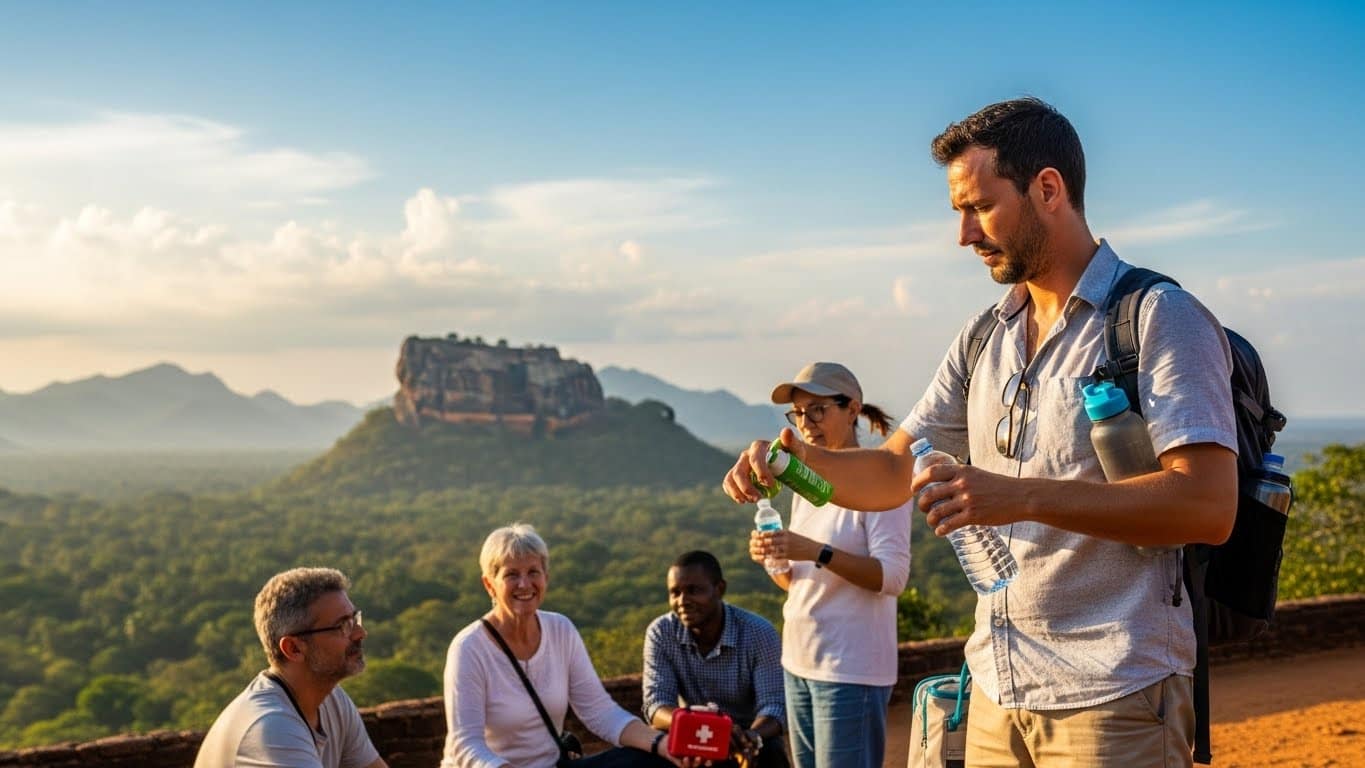
- Drink 3–4 litres a day in the heat, more if you're climbing or cycling. Carry oral rehydration salts.
- Do strenuous sightseeing before 10 AM or after 3:30 PM. Sigiriya, Anuradhapura and Polonnaruwa have little shade.
- Treat any animal bite or scratch as a same-day hospital visit. Rabies is present and is fatal once symptoms start.
- Call 1990 for the free Suwa Seriya ambulance.
Dengue: the risk worth taking seriously
Dengue is present across Sri Lanka all year. Cases rise during and just after the monsoon rains, roughly May–July and October–January, because rain leaves standing water where mosquitoes breed. Colombo, Gampaha and Kandy usually report the most cases, but no region is dengue-free.
Malaria is a different story. Sri Lanka was certified malaria-free by the World Health Organization in 2016, so you don't need antimalarial tablets for a normal trip.
Know your mosquito
Dengue is carried by Aedes mosquitoes, which have black-and-white striped legs and bite mostly in daylight, especially in the early morning and late afternoon. That is why "I'll use repellent in the evening" doesn't work here. The mosquito most likely to give you dengue bites while you're having breakfast on a guesthouse veranda or walking around a temple at 4 PM.
Repellent that actually works
Look for one of these active ingredients:
| Ingredient | Strength to look for | Notes |
|---|---|---|
| DEET | 20–50% | The most tested option. Higher strength lasts longer but doesn't protect better. |
| Picaridin (icaridin) | 20% | As effective as DEET, doesn't smell and doesn't damage plastics. |
| Oil of lemon eucalyptus (PMD) | 30% | A plant-based option that works. Not for children under 3. |
Repellents sold locally are often citronella-based and wear off within an hour or two, and strong DEET or picaridin can be hard to find outside Colombo. Bring enough from home for the whole trip, roughly one 100 ml bottle per person per week.
How to use it:
- Put on sunscreen first, then repellent about 15 minutes later.
- Reapply after swimming or heavy sweating, and at least as often as the label says.
- Don't forget ankles, the back of the neck and ears.
- For babies under 2 months, use nets and clothing, not repellent.
Clothes, rooms and nets
- Cover up at the high-risk times. Light, loose long sleeves and trousers help, especially early morning and late afternoon. Clothing treated with permethrin (you can spray it on your clothes before you leave home) adds another layer of protection.
- Air-conditioning helps. Mosquitoes struggle in cool, closed rooms. In fan-only rooms, check the window screens and use the net if one is provided.
- Plug-in vaporisers and coils are sold in every supermarket. They are useful in your room but are not a substitute for repellent on your skin.
Symptoms and what to do
Dengue usually starts 4–10 days after the bite, with:
- sudden high fever
- severe headache, often behind the eyes
- muscle and joint pain (the old name is "breakbone fever")
- nausea, and sometimes a rash a few days later
If you have a fever in Sri Lanka, or within two weeks of leaving, get a blood test. Private hospitals and labs in most towns can run a full blood count and a dengue test (NS1) the same day without an appointment.
While you wait for results:
- Take paracetamol only. Ibuprofen, aspirin, diclofenac and other NSAIDs increase bleeding risk in dengue.
- Rest, and drink plenty of fluids: water, oral rehydration salts, king coconut water, soups.
- Don't stay alone. Tell your guesthouse host or a travel partner.
The dangerous phase often comes as the fever drops, usually around days 3–7. Feeling better on day 4 doesn't mean you're out of danger. Go to hospital immediately if you notice any of these:
- severe stomach pain, or vomiting that won't stop
- bleeding from the gums or nose, blood in vomit or stool, or new bruising
- cold, clammy skin, or feeling restless, very drowsy or confused
- urinating very little
Most people recover fully with good monitoring and fluids. The point of the blood test is to catch the small number who need hospital care, early.
Heat: why the Cultural Triangle catches people out
Coastal Sri Lanka is humid. The dry zone around Sigiriya, Dambulla, Anuradhapura and Polonnaruwa is humid and hot, with exposed rock and stone and very little shade. Temperatures of 32–35°C are normal, and March to May is the hottest stretch.
Humidity matters because sweat doesn't evaporate well, so your body cools less effectively. 32°C at 80% humidity can feel well over 38°C.
Heat exhaustion vs heat stroke
| Heat exhaustion | Heat stroke | |
|---|---|---|
| Skin | Pale, cool, sweaty | Hot, red, may be dry |
| Mind | Tired, dizzy, headache | Confused, slurred speech, aggressive or drowsy |
| Other | Cramps, nausea, fast weak pulse | Fainting, seizures, body temperature 40°C or higher |
| What it means | A warning: your body is struggling | A medical emergency |
For heat exhaustion: stop, get into shade or air-conditioning, loosen clothing, sip water with oral rehydration salts, and wet the skin while fanning. You should feel clearly better within 30 minutes. If you don't, get medical help.
For heat stroke: call 1990 straight away. Cool the person as fast as you can while you wait: shade, cold water poured over the body, wet cloths and fanning, ice packs at the neck, armpits and groin. Don't give drinks to someone who is confused or drowsy.
Planning around the heat
- Start early. Sigiriya's ticket office opens around 7 AM. Be at the gate then, and you'll do most of the 1,200-step climb before the rock heats up.
- Split big sites into two sessions. Explore Anuradhapura or Polonnaruwa from about 7–10:30 AM, rest through midday, and go back out after 3:30 PM. Both sites are large, and cycling between monuments in the midday sun is how people overheat.
- Wear a hat, sunscreen and light, loose clothes. Sunburn makes it harder for your body to cool down.
- Give yourself 2–3 days to adjust before your hardest climb if you've flown in from a cold country.
- Go easy on alcohol the night before a big climb.
Hydration: how much is enough
The "eight glasses a day" rule doesn't apply here. In the lowland heat, plan on:
- 3–4 litres a day for a normal sightseeing day
- about 0.5–1 litre extra per hour of hard activity, such as climbing, cycling or hiking
- at least 1.5 litres per person carried up Sigiriya or Pidurangala
Your urine is the easiest check. Pale straw colour is fine. Dark yellow means drink now.
Water alone isn't always enough
When you sweat a lot, you lose salt as well as water. Drinking large amounts of plain water can leave you feeling weak, nauseous and crampy.
- Oral rehydration salts (ORS) are sold cheaply in every pharmacy. The local brand is Jeewani. Mix one sachet into the amount of clean water stated on the packet, and use it on hot, active days or after stomach upsets.
- King coconut (thambili) is sold at roadside stalls everywhere. It's a good drink, but it contains a lot of potassium and little sodium, so it doesn't replace ORS.
- Sports drinks are fine in moderation. They're sugary but won't dehydrate you.
Drinking water
Don't drink tap water. Use sealed bottled water, filtered water from your hotel, or your own purifier bottle, and check the seal on bottled water. Ice in hotels and established restaurants is usually made from treated water. At small roadside places, skip the ice if you're unsure.
For more on avoiding stomach trouble, see our guide to eating like a local without getting sick.
Rabies and animal bites
This is the risk travellers most often underestimate. Sri Lanka has many free-roaming dogs and cats, and monkeys around temples and ruins such as Polonnaruwa, Dambulla and Kandy. Rabies is present, and once symptoms appear it is almost always fatal. Treatment started promptly after exposure works.
If you're bitten, scratched, or licked on broken skin by any mammal:
- Wash the wound right away with soap and running water for 15 minutes. This genuinely reduces risk.
- Apply an antiseptic such as povidone-iodine if you have it.
- Go to a hospital the same day for rabies treatment, even if you were vaccinated before your trip. Government hospitals provide it, and private hospitals can arrange it.
- Note where it happened and what the animal looked like. Don't try to catch it.
To avoid bites: don't feed or touch dogs, cats or monkeys. Keep food out of sight at temples, where monkeys grab bags. Don't run from a dog that approaches you.
A pre-travel rabies vaccine is worth discussing with your clinic if you're staying for a long time, cycling, running, or travelling with children, who are bitten more often and may not tell you.
Our wildlife safety guide has more on avoiding dogs, monkeys and snakes.
Smaller things that can spoil a day
- Sunburn. Sri Lanka is close to the equator, so you burn faster than you expect, even on cloudy days. Use SPF 30 or higher and reapply every 2 hours and after swimming. Choose a reef-friendly sunscreen if you're snorkelling.
- Leeches. They're common in rainforest and hill country after rain, for example at Sinharaja, the Knuckles range and Horton Plains trails. Leech socks or tucked-in trousers help. They're harmless, but the bites bleed for a while, so pull them off sideways rather than yanking.
- Cuts and scrapes. Small wounds get infected easily in humid weather. Clean them well, keep them covered and dry, and see a doctor if the redness spreads.
- Hill country cold. Nuwara Eliya sits at about 1,900 m, and nights can drop below 10°C. Pack a warm layer. Our weather and packing guide covers this region by region.
Heading into the hills? Read our hiking safety guide.
Getting medical help in Sri Lanka
| Number | Service |
|---|---|
| 1990 | Suwa Seriya ambulance: free, island-wide, 24/7 |
| 119 | Police emergency |
| 110 | Fire and rescue (some sources list 111) |
| 1912 | Sri Lanka Tourism hotline |
- Pharmacies are everywhere, and many common medicines are sold without a prescription. Pharmacists are a useful first stop for minor problems.
- Government hospitals treat everyone free of charge and are experienced with dengue and animal bites, but expect queues and basic facilities.
- Private hospitals in Colombo, Kandy, Galle and other larger towns are faster and used to foreign patients. Expect to pay upfront and claim from your insurer afterwards.
- Travel insurance with medical cover is essential. Check that it covers hospital stays and medical evacuation. Call your insurer's emergency line early, because many insurers need to authorise treatment.
Keep these numbers and your insurer's emergency line in your phone. Our emergency preparedness toolkit has a full checklist.
What to pack
- DEET or picaridin repellent, enough for the whole trip
- Sunscreen SPF 30+ and a hat
- Oral rehydration salts (or buy Jeewani on arrival)
- Paracetamol for pain and fever. If you also pack ibuprofen, don't use it for a fever.
- Anti-diarrhoea tablets, plus any antibiotic your doctor prescribes for travellers' diarrhoea
- Antihistamine tablets and a hydrocortisone cream for bites
- Antiseptic, plasters and blister dressings
- Your regular medicines in their original packaging, with a copy of the prescription
- A reusable water bottle, ideally with a filter
Vaccines to ask about
Talk to a travel clinic, ideally 4–6 weeks before departure. Commonly recommended for Sri Lanka:
- Routine vaccines up to date (tetanus, diphtheria, measles)
- Hepatitis A and typhoid
- Depending on your trip: hepatitis B, rabies and Japanese encephalitis (for longer rural stays)
There's also a dengue vaccine, but it isn't suitable for everyone. Ask your clinic whether it makes sense for you.
FAQ
Is dengue common among tourists in Sri Lanka?
Most visitors never catch it, but cases among travellers do happen every year, especially around the monsoons. Repellent during the day, covering up and air-conditioned rooms cut your risk significantly. The most important habit is to get any fever tested rather than waiting it out.
Can I take ibuprofen for a headache in Sri Lanka?
For an ordinary headache with no fever, it's generally fine. If you have a fever or flu-like symptoms, use paracetamol only until dengue has been ruled out, because ibuprofen and aspirin raise the risk of bleeding.
Do I need malaria tablets?
No. Sri Lanka has been malaria-free since 2016. Concentrate on daytime mosquito protection against dengue.
Is it safe to climb Sigiriya in the heat?
Yes, if you go early. Arrive when it opens around 7 AM, carry at least 1.5 litres of water per person, and take breaks in the shaded sections. If you feel dizzy, confused or stop sweating, stop and get into shade, and call for help if it doesn't improve quickly.
A street dog scratched me but there's no blood. Do I need treatment?
Wash it well with soap and water for 15 minutes, then have it checked at a hospital the same day. Scratches can still transmit rabies, and only a clinician can judge the risk.
What should I do if I feel unwell?
For a fever, get a dengue blood test at a private hospital or lab. For anything severe, such as confusion, heavy bleeding or trouble breathing, call 1990. Then contact your insurance provider.
Travel Sri Lanka with Sri Lanka Safe
Fair tuk-tuk prices, scam alerts, offline emergency contacts and AI trip planning, in one free app.