Sri Lanka Wildlife Safety: Elephants, Dogs, Snakes and More
What to do if a wild elephant blocks your road in Sri Lanka, how to choose a safari jeep, and how to deal with monkeys, stray dogs, snakes, wasps and leeches.
Seeing wild elephants is one of the best reasons to visit Sri Lanka. Most wildlife encounters here are safe and memorable, as long as you give animals space and don't offer them food.
The animals most likely to cause you problems aren't the dramatic ones. A stray dog bite is more likely to affect your trip than a leopard, and a monkey is more likely to take your phone than an elephant is to charge your jeep. This guide covers them all, in order of what you're likely to meet.
This is general travel advice, not medical advice. After any serious bite or sting, get medical help straight away. Call 1990 for a free ambulance.
The short version
- Stay at least 50 metres from elephants where you can, and never feed them.
- Stay in the vehicle in parks and on jungle roads.
- Don't travel on jungle roads by bicycle, scooter or tuk-tuk at dusk or at night if you can avoid it.
- Treat any animal bite or scratch as a same-day hospital visit, because of rabies.
- Go straight to hospital after a snakebite. Don't cut it, suck it or use a tourniquet.
Elephants on the road
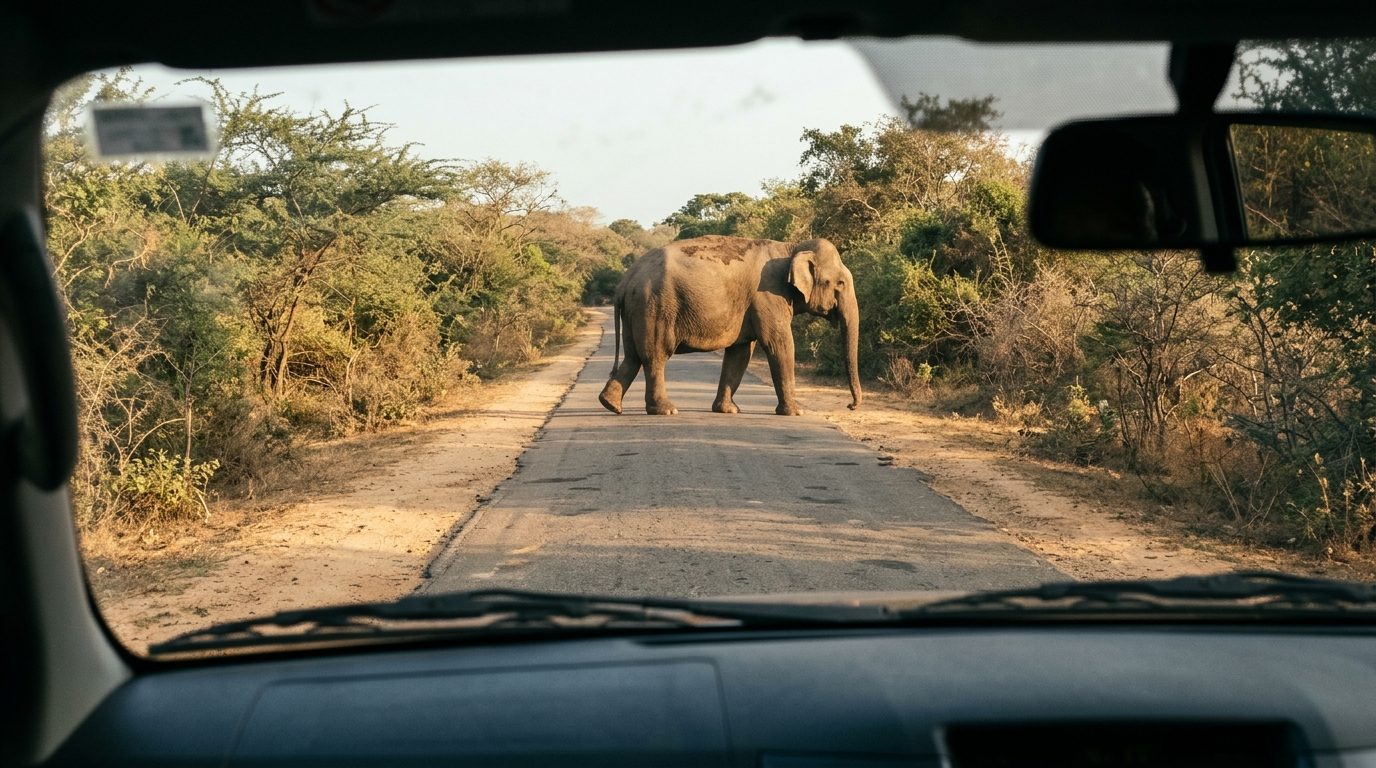
You can meet wild elephants on ordinary public roads near parks, particularly around Habarana, Udawalawe, and the Buttala–Kataragama road near Yala. Some have learned that tourists mean food. In January 2025, an elephant blocked a tourist vehicle on the Buttala–Kataragama road and pushed its trunk through an open window. In 2026, an Australian couple reported an elephant getting into their rented tuk-tuk and tearing open their luggage.
If an elephant is on or near the road
- Stop well back, and leave yourself room to reverse. Don't try to squeeze past.
- Keep the engine running and stay in the vehicle.
- Close the windows, and keep food out of sight.
- Stay quiet. Don't honk, rev the engine or shine bright lights.
- Wait. Let the elephant move on, however long that takes, even if vehicles behind you are impatient.
- If it walks towards you, reverse slowly to keep your distance.
What not to do
- Don't feed elephants, even if you see other people doing it. Feeding is what teaches them to approach vehicles.
- Don't get out for a photo, or stop right next to one.
- Don't carry fruit or food in plain view, especially in a tuk-tuk, which has no doors.
Be especially careful with open vehicles. Scooters, bicycles and tuk-tuks give you little protection, and locals advise against cycling on jungle roads. A cyclist had a close call with a leopard on one such road. Plan to be off these roads by dusk, since animals are more active after dark. Our scooter and car rental guide has more on night driving.
Warning signs
An elephant that's stopped feeding, is facing you, has its ears out or shakes its head is telling you that you're too close. Move back. A male with dark fluid running from the side of its head may be in musth, a hormonal state that can make it aggressive, so give it far more room.
Choosing a safari
Safaris themselves are usually safe. The biggest problems are crowding and speeding jeeps, and you can choose an operator who avoids them.
Look for:
- A jeep that's registered with the Department of Wildlife Conservation (DWC) and a licensed driver. Only trained, certified drivers have been allowed in Yala's main block since January 2024.
- A driver who stays on marked tracks, keeps to speed limits and gives animals room. DWC has temporarily barred dozens of jeeps from Yala for speeding and other violations.
- Seats with something to hold onto, because tracks are rough.
- Reviews that mention calm driving, not just the number of leopards seen.
Avoid anyone who:
- Promises a leopard sighting, or offers to chase one for a tip
- Races other jeeps to a sighting
- Gets very close to animals or blocks their path
- Lets passengers stand on the seats or get out of the jeep
Your part: Stay inside the vehicle, keep quiet and take your rubbish back out. Don't feed anything. A polite request such as "please stop here, this is close enough" is reasonable. If the driver ignores you, tell the operator and leave a review.
Check for closures
Parks can close at short notice. In 2026, Yala's Blocks 1 and 2 closed from 14 September to 15 October because of drought, and reopened on 16 October. Check the current situation with your operator before you book a long trip around a safari. Bring water, sun protection and a light layer for early-morning starts.
Monkeys
Toque macaques and other monkeys live around temples, ruins and hotels, including Dambulla, Polonnaruwa, Sigiriya and Kandy. They're quick, bold and good at opening bags.
- Don't feed them or show them food, including plastic bags, which they associate with food.
- Zip up your bag and put your phone and sunglasses away when they're around.
- Keep balcony doors shut when you're out of the room.
- If a monkey grabs something, let go. It isn't worth a bite.
- Don't stare or show your teeth, as a smile can look like a threat.
A monkey bite or scratch needs the same rabies treatment as a dog bite.
Stray dogs and rabies
You'll see free-roaming dogs everywhere. Most are calm and ignore people, but rabies is present and almost always fatal once symptoms start.
Avoiding bites:
- Don't pet or feed dogs, cats or puppies, however friendly they look.
- Don't run or cycle at speed past them. If a dog comes at you, stop, stand side-on and back away slowly.
- Leave dogs alone when they're sleeping, eating or with puppies.
- Keep an eye on children, who are bitten more often and may not tell you.
If you're bitten, scratched, or licked on broken skin:
- Wash the wound right away with soap and running water for 15 minutes.
- Apply an antiseptic such as povidone-iodine if you have it.
- Go to a hospital the same day, even if you've had the rabies vaccine.
Our tropical health guide covers rabies and the pre-travel vaccine in more detail.
Snakes
The Sri Lanka Medical Association lists the snakes of greatest concern as the cobra, common krait, Sri Lankan krait, Russell's viper and hump-nosed pit vipers. Most snakes you might see are harmless, and bites are uncommon for tourists, but serious bites do happen, mainly in rural areas.
Avoiding bites:
- Wear closed shoes and long trousers on trails and through long grass.
- Use a torch at night, including on short walks in rural guesthouse gardens.
- Don't put your hands in holes or wood piles, or under rocks.
- Sleep under a net and off the floor in rural accommodation, as kraits are active at night.
- Leave any snake alone. Many bites happen when people try to catch or kill one.
If someone is bitten:
- Keep them calm and still, and move them away from the snake.
- Keep the bitten limb still, as you would with a fracture. Remove rings, watches and tight clothing.
- Get to a hospital straight away. Call 1990, or go by the fastest vehicle available. Ask for a larger hospital if you have a choice, because antivenom is only available at some.
- Don't cut or suck the wound, use a tourniquet or apply ice, and don't use herbal remedies or see a traditional healer instead.
- Take a photo of the snake only if you can do so safely. Don't chase it.
Go to hospital even if you feel fine. Symptoms can take hours to appear.
Wasps at Sigiriya
Wasps nest on Sigiriya Rock, and attacks have happened for years. The most recent we found was in August 2024, when wind broke part of a nest and 22 foreign tourists were hospitalised. Visits were suspended for a while.
- Authorities have said nesting usually runs from about April to September.
- Climb quietly, and follow the signs and staff instructions.
- Don't use strong perfume, and don't flap your arms if wasps are around.
- If you're allergic to stings, carry your medication and tell your group.
- If there's an attack, get away from the nest and cover your face. Call 1990 for breathing problems, facial swelling or many stings.
Leeches
Leeches are common in rainforest and hill country after rain, including at Sinharaja, Knuckles and on Horton Plains trails. They're unpleasant but harmless.
- Wear leech socks or tuck your trousers into your socks.
- Check your legs and boots regularly.
- Slide them off sideways with a fingernail. Don't burn or yank them.
- Clean the bite and cover it. It may bleed for a while, which is normal.
Crocodiles
Crocodiles live in some lagoons, rivers and reservoirs, including near popular areas, and the UK government warns that they occasionally attack people. Don't swim or wade in fresh or brackish water unless locals say it's safe, and stay back from the water's edge at dawn and dusk.
Insurance
Check that your travel insurance covers medical treatment, evacuation and personal belongings. An Australian traveller had to claim for luggage damaged by an elephant, so it isn't as unlikely as it sounds.
FAQ
Is it safe to go on safari in Sri Lanka?
Yes, with a licensed operator and a careful driver. Stay in the jeep, keep your distance and don't encourage your driver to rush after sightings.
What should I do if a wild elephant comes towards my car?
Stay inside and reverse slowly to keep your distance. Don't honk, rev the engine or get out. Keep food hidden, and wait for the elephant to move on.
Should I get a rabies vaccine for Sri Lanka?
Ask a travel clinic, especially if you're staying a long time, cycling, running or travelling with children. Even if you've been vaccinated, you'll still need treatment after a bite.
Are there dangerous snakes in Sri Lanka?
Yes, but bites are rare for tourists. Wear closed shoes on trails, carry a torch at night, and go straight to hospital if you're bitten.
Can I feed the elephants at the side of the road?
No. It encourages them to approach vehicles, which has caused injuries and damage. Keep driving, or stop well back.
When is the best time to visit Sigiriya to avoid wasps?
Wasps have been reported mainly between April and September, but attacks are unpredictable. Follow staff instructions, and bring your medication if you have a sting allergy.
For more, read our Sri Lanka travel safety tips and emergency guide. The Sri Lanka Safe app keeps emergency numbers available offline and sends alerts while you travel.
Sources
- UK government travel advice for Sri Lanka
- Sri Lanka Medical Association: snakebite guidelines, 2021
- Daily Mirror: elephant blocks tourist vehicle, 2025
- Canberra Times: elephant damages tourists' luggage, 2026
- Daily Mirror: cyclist's close call with a leopard
- Daily Mirror: certified drivers only in Yala
- Ada Derana: safari jeeps barred from Yala
- Newswire: Yala zones reopen, October 2026
- Newsfirst: wasp attack at Sigiriya, 2024
- Sunday Observer: Sigiriya wasp nesting season, 2012
Travel Sri Lanka with Sri Lanka Safe
Fair tuk-tuk prices, scam alerts, offline emergency contacts and AI trip planning, in one free app.