Sri Lanka Bus Guide: Routes, Fares & Safety
How to ride Sri Lanka's buses: red SLTB vs private buses, expressway coaches, 2026 fares, where to board, keeping your bags safe and surviving the hill roads.
Sri Lanka's buses go almost everywhere, leave every few minutes on main routes and cost very little. They're also loud, crowded and driven with real enthusiasm. With a bit of know-how they're a safe, memorable way to travel, and in 2026, with parts of the hill-country railway still closed after Cyclone Ditwah, they're often the only public transport into the mountains.
At a Glance
- Cost: from LKR 34 (the minimum fare since July 2026) to around LKR 1,000–1,500 for the longest AC routes
- Best for: budget travel, short and medium hops, and routes the train doesn't cover
- Most comfortable: expressway and AC intercity coaches
- Pay: cash to the conductor, in small notes
- Biggest risks: pickpockets in crowds, fast driving, motion sickness on mountain roads
Types of Bus
SLTB (government) buses
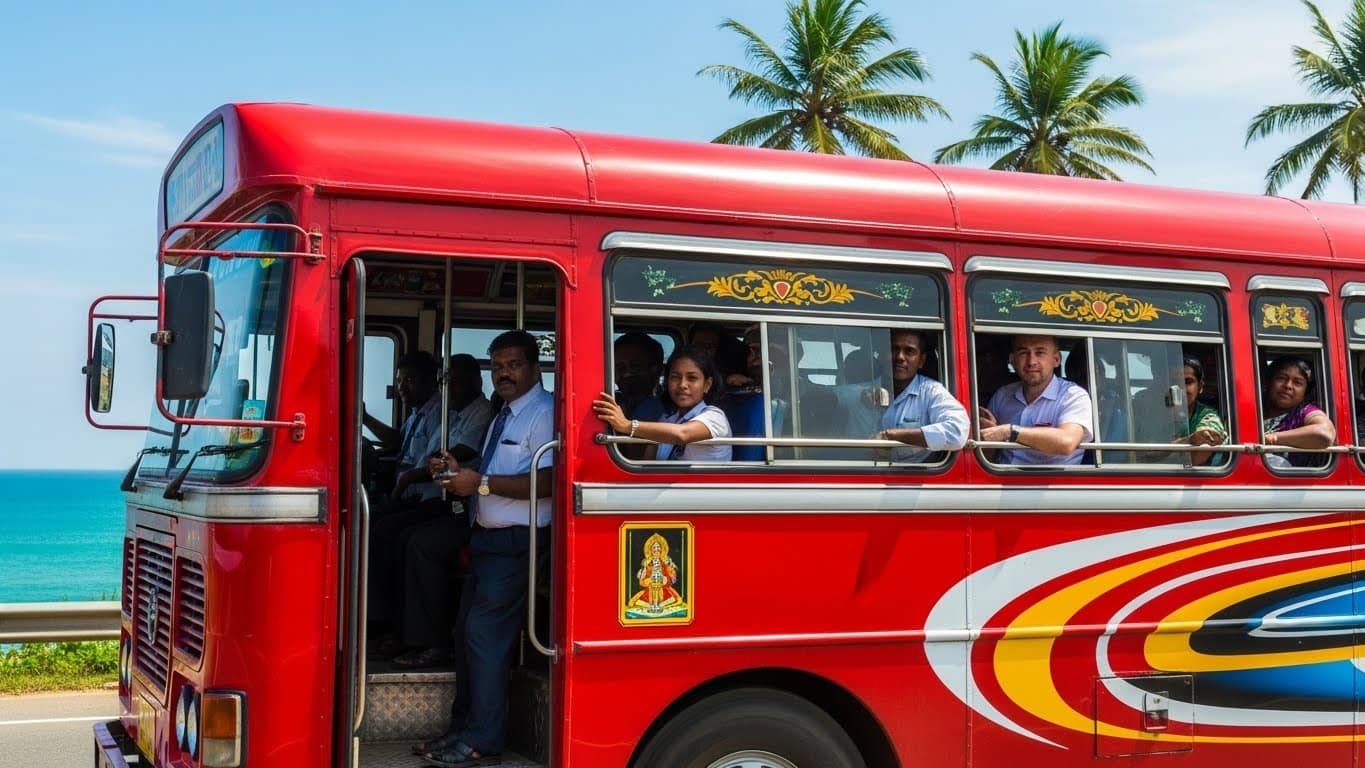
Run by the Sri Lanka Transport Board, these are the classic red buses. Fares are set by the National Transport Commission (NTC), drivers are state employees, and the front seats are reserved for clergy and people with disabilities. They tend to wait at stops longer and drive a little more calmly.
Private buses
Private operators run most services. Their buses come in every colour, often decorated with chrome, religious images, flashing lights and loud music. Fares follow the same NTC rates, but because crews compete for passengers, some drive aggressively to reach the next stop first.
Normal, semi-luxury and AC intercity
- Normal: No air conditioning, open windows, standing passengers. The cheapest option.
- Semi-luxury: Padded seats, sometimes fans. Fewer standing passengers.
- AC intercity / luxury: Air-conditioned minibuses or coaches that make fewer stops. They cost about twice the normal fare, are well worth it for long trips, and fill up fast.
Expressway buses
AC coaches on the Southern Expressway (E01) link Colombo with Galle, Matara and Hambantota in a fraction of the time the coast road takes. Most leave from the Makumbura Multimodal Centre near Kottawa, on Colombo's southern edge. There are also services from the airport and Kadawatha.
Fares (July 2026)
The NTC revised fares on 6 July 2026: the minimum fare rose to LKR 34, and longer routes rose by 12–20%. Typical fares:
| Route | Bus type | Approx. fare | Time |
|---|---|---|---|
| Colombo – Kandy | Normal | LKR 520 | 3.5–4 hrs |
| Colombo – Kandy | AC intercity | ~LKR 750 | 3–3.5 hrs |
| Makumbura – Galle | Expressway | LKR 930 | ~1.5 hrs |
| Makumbura – Matara | Expressway | ~LKR 1,170 | ~2 hrs |
| Short town hop | Normal | LKR 34–100 | – |
Fares change with fuel prices, so ask the conductor or check the NTC website. Conductors print a ticket that shows the fare, so keep it.
Where to Catch the Bus
- Colombo: The Central Bus Stand in Pettah (SLTB) and the private stand on Bastian Mawatha next door handle most long-distance routes. Expressway buses to the south leave from Makumbura.
- Kandy: The Goods Shed bus stand, next to the railway station, serves most destinations; the clock-tower stand handles local routes.
- Galle: The main bus stand faces the cricket stadium, a short walk from the fort.
- Ella: Buses stop on the main road in town. There are frequent connections to Badulla, Wellawaya and Bandarawela.
The front of each bus shows its destination, usually in Sinhala and often in English or Tamil too. Big stands are confusing, so ask a conductor or another passenger; people are quick to help.
How It Works
- Flag the bus down with a raised arm. Buses stop where people are waiting, not only at marked stops.
- Get on quickly. Buses often start moving before everyone is fully aboard.
- Tell the conductor where you're going and pay when he comes round. Keep small notes ready.
- Ask the conductor to tell you when to get off. Following along on Google Maps helps too.
- Press the bell or call "bahinawa" ("getting off") just before your stop.
Luggage: Small bags go on your lap or the rack above you. Big backpacks may go beside the driver or at the back; on crowded buses you might be asked to pay an extra fare for a large bag.
Bus Etiquette
- The front seats are reserved for clergy (monks and nuns). Give them up, and women should avoid sitting directly beside a monk.
- Offer your seat to elderly passengers, pregnant women and parents with small children.
- Dress modestly and keep your phone calls short.
- Vendors hop on with snacks at big stops. Buy from busy sellers and choose hot food.
Keeping Your Things Safe
Crime on buses is mostly petty theft in crowds.
- Keep passport, phone, cards and cash on you, not in a bag on the rack.
- Wear your daypack on your front when standing, and keep zips closed and facing you.
- Be extra alert when boarding and getting off, and at the big Colombo stands. Crowding is when pickpockets act.
- Don't keep your phone in a back pocket or wave it out of an open window.
- Politely decline strangers who insist on carrying your bags.
Staying Safe on the Road
Bus drivers, especially on private competing routes, can be fast and take risky overtakes.
- On long trips, choose SLTB, AC intercity or expressway buses. They're generally calmer.
- Sit towards the middle, away from the door, and hold on tight if standing.
- If the driving frightens you, get off at the next town and catch another bus. There's almost always another one coming.
- Avoid long rural bus trips after dark.
- You can report dangerous driving to the NTC with the bus number and route.
Surviving the Hill-Country Roads
The roads through Kandy, Nuwara Eliya, Hatton, Ella and Haputale are a series of hairpins, and motion sickness is common.
- Take a motion-sickness tablet 30–60 minutes before you leave. Pharmacies sell them without a prescription.
- Sit near the front, by a window, facing forward, and keep your eyes on the horizon rather than your phone.
- Eat lightly beforehand; ginger sweets help some people.
- Allow extra time in the monsoon, when landslides can close mountain roads.
Buses and the 2026 Railway Disruption
Cyclone Ditwah in late 2025 badly damaged the Main Line. As of late October 2026:
- Trains run between Nanu Oya and Badulla (including Ella). This section reopened on 20 June 2026.
- Kandy to Nanu Oya is still closed, and Colombo–Kandy services have been suspended again since 25 October 2026 after an earth slip.
For now, the usual way to reach Ella from Kandy is by bus or car to Nanu Oya (near Nuwara Eliya), then the scenic train onwards. Alternatively, take a bus all the way to Ella, about six hours from Kandy. Check Sri Lanka Railways before you go; sections are reopening in stages.
Sample Bus Trips
- Colombo to Galle in a day: Expressway bus from Makumbura to Galle (about 1.5 hours), walk the fort, take a local bus to Unawatuna for the beach, and return by expressway.
- Kandy to Ella (2026 route): Bus from Goods Shed to Nuwara Eliya (around 3 hours), stay overnight, then a short tuk-tuk to Nanu Oya for the morning train to Ella.
- Cultural Triangle: Bus from Colombo or Kandy to Dambulla, then local buses or tuk-tuks to Sigiriya (about 30 minutes) and Polonnaruwa (about 1.5 hours).
FAQ
Are buses safe for tourists? Yes, with the usual care for your belongings. Choose AC or expressway buses for long trips and avoid rural buses late at night.
Can I book in advance? Normal buses: no, just turn up. Some AC intercity and expressway services can be booked online or by phone through operators or booking sites, which is worth doing on busy holiday weekends.
Can I pay by card? No. Fares are cash only, in rupees.
What if I miss my stop? Get off at the next one and take a bus back or a tuk-tuk. It happens to everyone.
Are buses good for women travelling alone? Generally yes, during the day. Sit next to other women or near the front when you can, and see our solo female travel guide for more tips.
More Transport Guides
- How to get around Sri Lanka: the complete guide
- Fair tuk-tuk prices and how to negotiate
- Transport safety: buses, trains and drivers
The bus is the cheapest, most local way to see Sri Lanka. Keep your valuables close, choose the calmer buses for long trips, and enjoy the ride.
Travel Sri Lanka with Sri Lanka Safe
Fair tuk-tuk prices, scam alerts, offline emergency contacts and AI trip planning, in one free app.